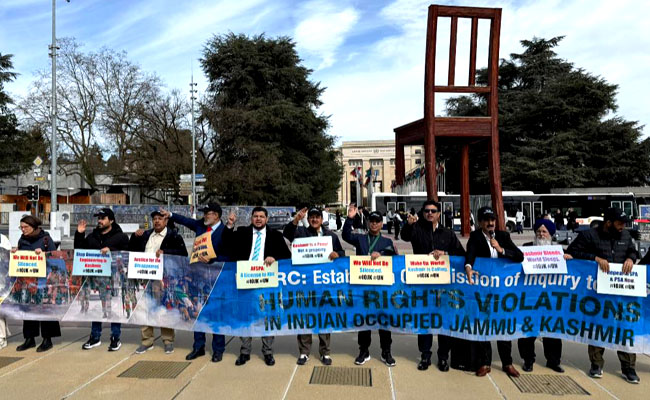
Geneva: A Kashmiri delegation staged a protest demonstration outside the United Nations headquarters in Geneva, urging the international community to play a more proactive role in resolving the long-standing Kashmir dispute, which they described as a serious threat to peace and stability in South Asia and a major cause of continued human rights violations in Indian illegally occupied Jammu and Kashmir (IIOJK).
Speaking on the occasion, Altaf Hussain Wani, Incharge of the Kashmir Delegation to the United Nations, said that the continued silence of the international community over the worsening human rights situation in IIOJK has emboldened India to intensify repression against the Kashmiri people. He urged the United Nations and global human rights organizations to take practical steps to ensure the implementation of UN Security Council resolutions on Jammu and Kashmir.
Fahim Kayani, President of Tehreek-e-Kashmir UK and President of the All Parties International Kashmir Coordination Committee, said that the Kashmiri diaspora will continue to highlight the plight of the Kashmiri people at international forums until their right to self-determination is realized. He stressed that lasting peace in South Asia cannot be achieved without a just resolution of the Kashmir dispute in accordance with UN resolutions.
Advocate Pervez Shah, Secretary General of the All Parties Hurriyat Conference AJK (APHC-AJK), said that the continued incarceration of Kashmiri political leaders and activists reflects India’s attempt to silence the legitimate political aspirations of the Kashmiri people. He called for the immediate release of all political prisoners.
Shamim Shawl, Executive Member of APHC-AJK said that despite decades of repression the Kashmiri people remain committed to their struggle for justice and freedom.
Sardar Amjad Yousaf, member of the Kashmir Delegation to the United Nations, said that the unresolved Kashmir dispute remains a constant threat to regional peace and urged the United Nations to play an active role in facilitating dialogue involving all relevant parties.
Speakers expressed deep concern over the deteriorating political and human rights situation in IIOJK, stating that since the illegal abrogation of the territory’s special status on August 5, 2019, the Indian government has increasingly used draconian laws such as the Public Safety Act (PSA) and Unlawful Activities (Prevention) Act (UAPA) to suppress dissent and detain Kashmiri political activists, journalists and human rights defenders.
They said the hardships faced by Kashmiris have intensified since the revocation of Kashmir’s special status, particularly after the Pahalgam incident, which they said was used as a pretext for collective punishment against Kashmiris, especially the youth. Thousands of civilians, mostly young boys, were taken into custody and continue to languish in distant jails with little access to their families.
The speakers also criticized New Delhi’s attempts to alter the demographic composition of IIOJK by granting domicile rights to outsiders and establishing new settlements, warning that such measures threaten the Muslim-majority character and identity of the territory.
Describing India’s actions as a violation of UN Security Council resolutions, the speakers urged the international community to ensure the protection of Kashmiri people’s identity, safeguard their political freedoms and support their right to self-determination.
They also called for the immediate release of detained Kashmiri leaders including Masarrat Aalam Bhat, Shabbir Ahmed Shah, Muhammad Yasin Malik, Nayeem Ahmed Khan, Asiya Andrabi and others.
Among others present on the occasion were Karan Singh, Asif Jarral, Awais Malik and other Kashmiri activists.