Fahim Kayani Raises IOJ&K Human Rights Concerns at UN Human Rights Council
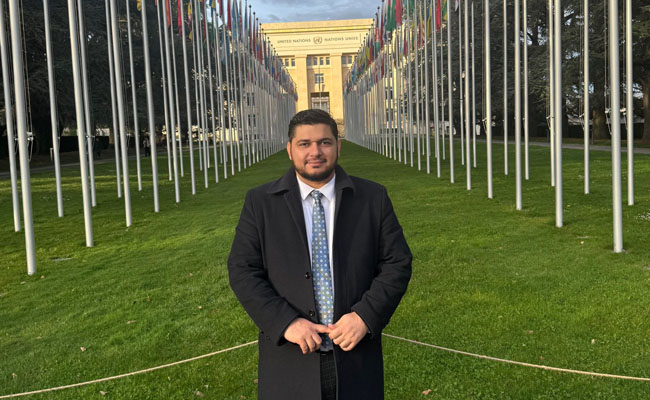
Geneva, Switzerland: Fahim Kayani, President of Tehreek-e-Kashmir UK and President of the All Parties International Kashmir Coordination Committee, raised serious concerns over the human rights situation in Indian-occupied Jammu and Kashmir during his address at the 61st session of the United Nations Human Rights Council in Geneva.
Speaking before the Council, Kayani highlighted what he described as a “deteriorating human rights situation” in the region, stating that political freedoms, due process, property rights, and the right to self-determination are facing increasing pressure.
He drew attention to the continued detention of hundreds of political prisoners, including Hurriyat leaders, journalists, scholars, lawyers, and students. Among those mentioned were Massarat Alam Butt, Yasin Malik, Shabbir Ahmed Shah, Aasiya Andrabi, Fahmeeda Sofi, Nayeem Ahmad Khan, Dr Abdul Hameed Fayaz, Zafar Akbar Bhat, human rights defender Khurram Parvez, and journalist Irfan Mehraj, who he said remain incarcerated under stringent laws.
Kayani also raised concerns over delays in the justice system, noting that 351 sessions cases have been pending for more than five years, which he said reflects prolonged trials and denial of due process.
Addressing digital freedoms, he referred to a recent case in Budgam district where a resident, Suhail Ahmad Bhat, was booked by police over allegations of sharing “provocative” content on social media. Kayani said such cases demonstrate how vague accusations are being used to criminalise online expression.
He further highlighted reports of property seizures in the region, stating that authorities are increasingly labeling exiled Kashmiris as “operating from abroad” to justify the confiscation of homes and land. According to him, critics warn that such practices risk dispossessing local populations and could contribute to demographic changes.
Concluding his remarks, Kayani urged the United Nations Human Rights Council to closely monitor the situation and take steps to address what he described as the continuing erosion of fundamental rights in Jammu and Kashmir.